




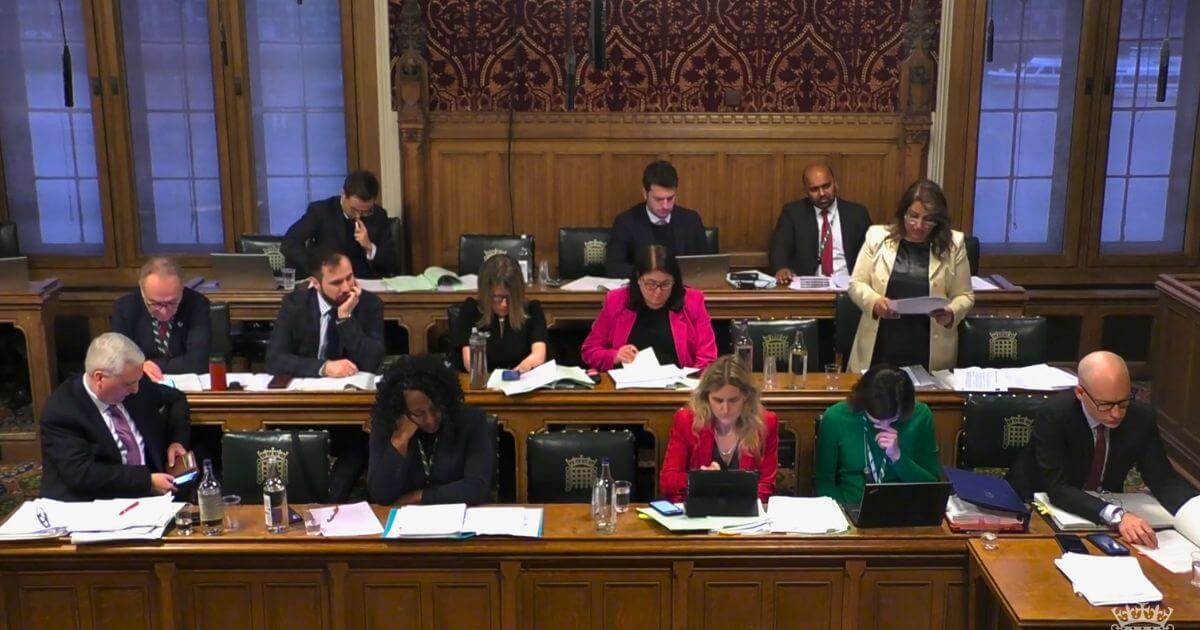
The assisted suicide Bill Committee scrutinising Kim Leadbeater’s Terminally Ill Adults (End of Life) Bill, which passed its Second Reading on 29 November 2024, met for its third week of sittings last month to continue its line-by-line scrutiny of the Bill.
On 25 and 26 February, MPs further considered clause 1 of the Bill, as well as clauses 2, 3 and aspects of clause 4. By the end of the first day, the Committee had rejected all 80 amendments seeking to improve safeguards to protect the most vulnerable from assisted suicide including an amendment to guarantee a specialist palliative care consultation for anyone considering assisted suicide and amendments to protect people with anorexia and diabetes too; the Bill’s sponsor, Kim Leadbeater, had refused to provide assurances that she would oppose any future expansion of assisted suicide law; and Leadbeater denied supporting Oregon-based assisted suicide law despite praising Oregon’s law publicly in October.
By the end of the second day, MPs had rejected amendments to ensure mental capacity is proven beyond reasonable doubt and not simply assumed before assisted suicide can be approved; Clause 3 of the Bill, relating to mental capacity, had been passed by Leadbeater’s supporters with every proposed amendment to strengthen safeguards rejected; MPs were reminded that evidence suggests deaths by assisted suicide drugs may be traumatic rather than painless and were warned that the Bill would undermine suicide prevention strategies; Government Ministers continued to reject important amendments on the grounds that the Bill ought to be kept “simple”; a Government minister refused to deny that the Government considers assisted suicide to be ‘healthcare’; and MPs had been warned that it would be dangerous for doctors to be allowed to raise assisted suicide with patients, which is currently permitted under the Bill.
At the same time, during Prime Minister’s Questions, the Prime Minister told the House of Commons that “one death by suicide is one too many”, even while Parliament is considering passing a Bill that would lead to thousands of assisted suicides every year.
The Committee will return tomorrow to vote on whether to add safeguards for other vulnerable people.
During the scrutiny, a number of key themes emerged, demonstrating widespread concerns about many aspects of the Bill.
Assisted suicide permissible for being a burden and to save family money
Principal opponent of the Bill, Danny Kruger offered an important summary of what is permitted under the Bill as written, which, he argued, is contrary to what the public wants. If you meet the six-month requirement and are regarded as having capacity, “the fact is that under this Bill you can be depressed and suicidal and still regarded as having capacity to have an assisted death. You can be very marginalised—you can be a prisoner, you can be homeless—and still be regarded as eligible. You can have been influenced or encouraged by others and still be eligible. You can do it because you feel a burden. You do not need to be in any kind of pain. You do not need to be in the tiny proportion of cases that palliative care cannot help”.
He went on: “[Y]ou can seek an assisted death for the sole reason of saving your family money, and you would be granted an assisted death on those grounds. The fact is that in rejecting these amendments, the Committee has decided and has demonstrated that the Bill is much wider than the campaigners portray”.
MPs challenge the Government’s “neutrality” and process
As in previous Committee sessions, MPs drew attention to issues with the process of the Bill and questioned the Government’s neutrality.
Minister Stephen Kinnock stated the “Government remain neutral on the substantive policy questions relevant to how the law in this area would be changed” even while advancing the position that a particular amendment “is workable, effective and enforceable”. The Minister also claimed to be personally in agreement with Danny Kruger’s amendment seeking to ensure that a terminal illness under the Bill can only be an illness or a disease and not a medical condition, yet opposed the amendment in his role as Government Minister.
In response to Kinnock’s claim that he was neutral on “the substantial philosophical, ethical and moral policy considerations” but perhaps not so on the “operational impacts” Rebecca Paul MP said “You mentioned various moral issues that you are not commenting on, but in reality the decision on this increases the number of people who would be considered to have capacity. I suggest that that might not actually be a neutral position to take; it has a broader impact”.
Naz Shah MP returned to her concerns about the lack of an impact assessment and also questioned the Government’s neutrality on the assisted suicide Bill. She said that “[w]ithout the impact assessment, how do we know what we are dealing with? That would be a normal way of progressing a Bill and dealing with amendments such as these. It feels as though we have just talked about something when the Government have already had a position on it, or have supported a particular position on an amendment”.
Drawing attention to the overall issue of advancing this legislation through a Private Member’s Bill rather than a Government Bill, Naz Shah said “that [this] places an even heavier burden on us to get things right. We cannot ignore the testimony of those who have the most relevant experience. Too many Government Ministers, MPs and local councils from all parties, including mine, have done that in recent decades”.
Consequences of Bill and lethal drugs
Danny Kruger MP and Sarah Olney MP drew attention to some of the little-discussed aspects of the Bill, including the lethal drugs that might be used in assisted suicide and potential unintended side effects.
After pointing out that assisted suicide is not addressing any symptoms, condition or illness but rather ends your life, and so cannot properly be considered healthcare, Kruger explained that the limited evidence on the effects of lethal drugs comes from US executions, and it reveals that there can be trauma, distress and pain.
Olney said “it is important that people understand that any medical procedure can fail, including with an approved substance, and we do not know how long the substance will take to be effective”.
Speaking about the more general consequences of making assisted suicide legal, Danny Kruger MP quoted barrister Ruth Hughes saying “If the Bill is passed, then this will lead to some of the most vulnerable people dying for others’ financial gain. That is certain”.
Assisted suicide and suicide prevention
Sarah Olney referenced commentary from the previous week in which Professor Louis Appleby, who chairs the Government’s National Suicide Prevention Strategy Advisory Group, had suggested that making assisted suicide legal could undermine suicide prevention strategy.
Building on the same theme, Danny Kruger again pointed out the inconsistency between suicide prevention efforts and legalising assisted suicide, saying “How can we say that somebody who is about to take their own life, unassisted, does not have capacity and is not making a settled and informed wish? In which case, why should we stop them or try to wrestle them back from the edge?”.
“We are assuming capacity in the person who wants to end their own life. I suggest that that presents a real challenge to our national suicide prevention strategy—I will leave that point there, but I welcome any challenges to it”, he went on.
Rebecca Paul MP said “[W]hen we tell our young people that suicide is not the answer and to seek help, we must do so knowing full well that the key message will be undermined by the availability of an assisted dying service, which may be plastered across billboards and advertised on daytime TV”.
Should the assisted suicide Bill be simple or safe?
Pro-assisted suicide MP, Dr Simon Opher, argued that the Bill be “as simple as possible, because that is the best safeguard” and Minister Stephen Kinnock emphasised that “clarity or workability” were key to the Government’s perspective on the Bill.
However, Danny Kruger MP was unsure about the rationale for this asking “I really want someone to explain this point to me: how can it make it more unsafe for patients to state the safeguards explicitly? How can it possibly make it harder, or more dangerous, if we specify what—as [Opher] said—is good practice currently, which the best doctors already do? I greatly respect him and his medical practice, but is he really saying that every doctor conforms perfectly to the GMC guidance?”.
Rebecca Paul MP challenged the Minister on his apparent commitment to avoid “operational challenges” as a reason to oppose amendments saying “Does he recognise that what is being said today is that operational reasons are driving the decision we make with respect to capacity? We are talking about a decision for someone to end their life. Does he not think that that would absolutely warrant us doing something that might be slightly more difficult operationally, and taking a two-tier approach?”.
The Minister suggested that the best way forward was to avoid “complexity” in the legislation and introduce “regulations and training” to tackle at least some of the issues raised by particular amendments.
Should doctors be permitted to bring up assisted suicide with a patient unprompted?
Juliet Campbell, as well as other MPs including Naz Shah and Danny Kruger, argued that physicians should not be permitted to raise assisted suicide with a patient unprompted.
“The doctor’s position is one of knowledge and expertise that far exceeds that of their patient, and that places them in a position of power and influence over their patient. Given that power imbalance, the doctor’s suggestion seems like a recommendation. If an individual chooses assisted death because it feels like a recommendation, that decision is no longer autonomous”, she said.
“By removing the option of a healthcare professional first raising assisted dying with a patient, we seek to alleviate the risks that already marginalised groups would be subject to with regard to assisted dying if a healthcare professional suggested it to them first”, she added.
Kruger expressed alarm about the possibility, suggested by pro-assisted suicide MP Kit Malthouse, that every patient near the end of their life should be informed of assisted suicide.
Kruger said “I think [Kit Malthouse] is suggesting that a doctor should suggest assisted dying as an option in every case, because if he is suggesting that a reasonable patient would want to know this towards the end of their life, he is saying that every dying patient should be told, “What about assisted dying?” That is a very concerning suggestion. The question is: how would a doctor decide when or when not to make this suggestion?”.
He followed up, asking the Committee “I would like to hear from any Member who has an answer to this: in what circumstances might it be appropriate for a doctor to suggest assisted dying?”.
Kruger went on to argue that since assisted suicide is not a medical treatment it should not be raised by the doctor at all. “Either this is a medical treatment—in which it should be obligatory for a doctor presented with a patient who qualifies under the Bill and has the symptoms that we are talking about to say, ‘By the way, there is also this option’… or it is not a healthcare treatment at all. Clause 4(1) states that they do not have to raise the subject, in which case they should not raise it, because to raise it is to put it on a par with other healthcare options and therefore implicitly, or indeed pretty explicitly, to say, ‘This is an option that might be good for you’, which is an enormous communication to make”.
Assessing capacity: the insufficiency of the MCA
As happened during Committee sessions earlier in the month, MPs returned to the topic of the role of the Mental Capacity Act (MCA) and whether it was an appropriate tool for assisted suicide.
Sojan Joseph MP quoted the Royal College of Psychiatrists, stating that capacity assessments are opinions with margins of error and are time-specific.
Rebecca Paul said she considered “the bar for the capacity to make a decision to seek an assisted death to be far too low if, as we have already discussed, the approach currently proposed in the Bill is adopted”. She laid out the “powerful written evidence” the Committee had received, explaining that the MCA is not suitable for assisted suicide. She backed up her claim with reference to the Royal College of Psychiatrists saying “It is the RCPsych’s view that the MCA is not sufficient for the purposes of this Bill”, as well as eating disorders expert Chelsea Roff and Professor Gareth Owen, both of whom gave evidence to the Committee at the end of January.
Assisted suicide in the case of anorexia
Rebecca Paul, Danny Kruger and Naz Shah all argued that the Bill in its current form could permit assisted suicide for someone with anorexia under certain circumstances.
Shah explained that “If we wish to protect people with anorexia and other eating disorders, we must rewrite the Bill. We must ensure that people who have those disorders, and who also have a physical disorder, cannot qualify for assisted dying. I must underline that this is not a hypothetical point or some clever objection that has been dreamed up without reference to the real world. It has actually happened—not once, but dozens of times in countries that have assisted dying”.
Kruger commented on “the reality in our NHS at the moment that people are described as terminally ill with anorexia. They are given the label of being terminally ill and put on palliative care pathways because it is assumed that their condition is not reversible. Doctors today, in this country, are concluding that people with eating disorders are going to die and are treating them accordingly”.