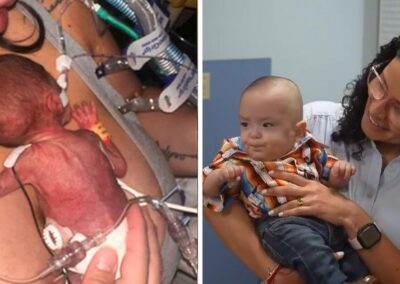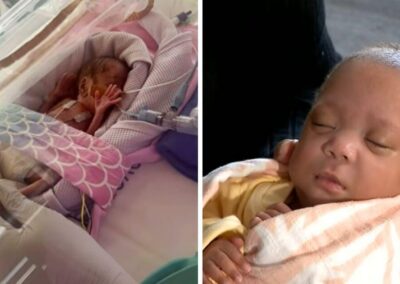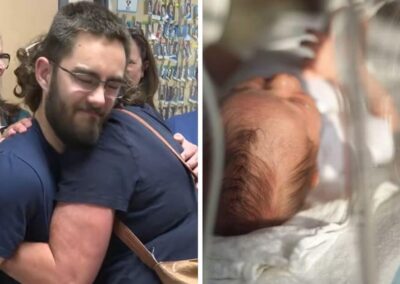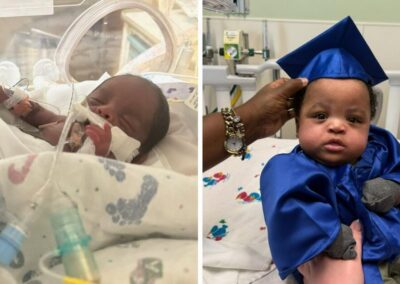




A baby girl who was born prematurely at 33 weeks, with a rare congenital condition and weighing just 4lb 15oz, is thriving in the aftermath of several operations.
When her mother Amanda Sullivan attended an ultrasound scan when she was just 20 weeks pregnant, doctors discovered her daughter was not developing properly. Baby Emilia had a mismatch in her small intestine, which would result in her needing surgery as soon as she was born.
“I didn’t induce labour; we wanted to keep Emilia in my belly as long as we could and had more frequent doctor visits to ensure Emilia wasn’t under any stress”, her mother said.
In a later scan, it was identified that Emilia’s belly was swollen in the womb, as fluid was unable to pass through her intestine. Amanda started having contractions a few weeks later and Emilia was born at just 33 weeks. She weighed four pounds and 15 ounces.
Emilia had to endure several surgeries when she was only a few weeks old
Little Emilia, from Platteville, Colorado, was diagnosed with a rare congenital condition called duodenal atresia where parts of Emilia’s intestines were not properly connected. This meant that baby Emilia would need surgery shortly after birth and likely further surgeries later in life.
Dr Jonathan Hills-Dunlap, a paediatric surgeon caring for Emilia, identified two issues with her gastrointestinal system.
“One was that the intestine wasn’t connected correctly, and the other was that her downstream intestine had formed an abnormal configuration that puts her at risk for life-threatening problems in the future as a result of that configuration”, he said.
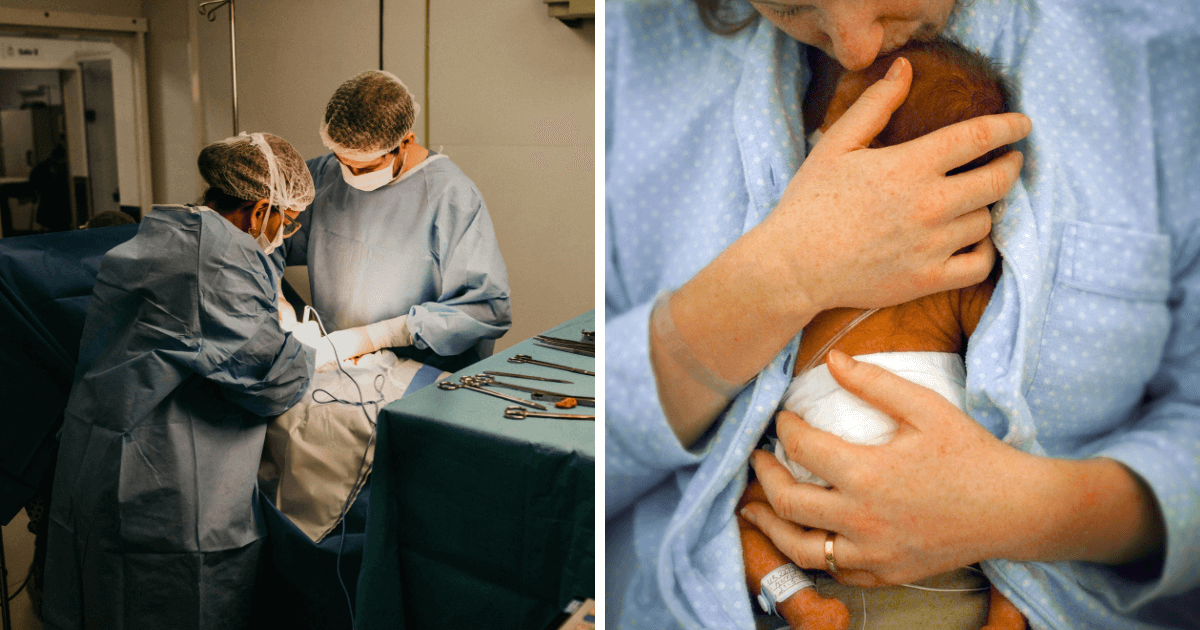
Emilia’s first life-saving surgery was scheduled for just three days after her birth. The procedure took seven hours.
“My job as a surgeon is to connect the two blind ends of the intestine back together, but sometimes the upstream blind pouch is much bigger than the downstream blind end; we call it a mismatch”, Dr Hills-Dunlap said.
“You can think about it as though I’m connecting a 10-lane highway to a one-lane highway and hoping that there won’t be too bad of a traffic jam. That’s exactly what Emilia has, a 10-to-1 size mismatch. That’s how much bigger her upstream intestine was compared to her downstream intestine”.
“(Operating on) a baby with intestines that small is like reattaching two pieces of angel hair pasta”, he added. “I used a surgical telescope to magnify the operation done through an incision over the belly, and she recovered beautifully from that operation”.
Since this initial surgery, Emilia has had a further procedure involving an expanding balloon being placed across the connection site from her first surgery.
“What we’re trying to accomplish here with Emilia is to expand the connection in order to make the passage wider”, said Dr Hills-Dunlap. “Therefore, we hope she can continue eating and growing and avoid any more major surgeries for as long as possible”.
Even with a long journey ahead, Emilia is thriving
In spite of the requirements for ongoing surgeries to support her intestinal connection, Emilia is doing well and growing appropriately.
“The fact that she’s now over seven months old, is taking all of her nutrition by mouth, and is growing and thriving otherwise is an amazing outcome for Emilia and her family”, Dr Hills-Dunlap said.
Emilia’s mum Amanda said that the surgeon, who has a child slightly older than Emilia, refers to her daughter as “his girl”.
“It’s humbling and gratifying to help babies, who are among the most vulnerable patients. Emilia was a very small baby, and only one day old when I met her, who literally couldn’t eat”, Dr Hills-Dunlap said. “To help patients like Emilia and allow them the opportunity to eat and grow and be happy and healthy is incredibly rewarding”.
“Emilia’s parents know we have a way to go with her, but she will tackle every challenge, and we are thrilled with how well she is doing”, he added. “She holds a special place in my heart”.
Spokesperson for Right To Life UK, Catherine Robinson, said “Congratulations to baby Emilia for surviving and thriving through her many surgeries. What a gift to be able to help children by providing life-saving treatments, and to support their families through challenging times. Good luck to Emilia and her family on their ongoing journey!”